


For decades, cross-border remittances have been a critical financial lifeline for individuals, businesses, and entire economies. Migrant workers send money home to support families, small and medium-sized enterprises (SMEs) pay international suppliers, and globalized digital services rely on fast, reliable settlement across borders. Yet despite their importance, traditional remittance models remain deeply inefficient, costly, and exclusionary.
According to global development institutions, hundreds of billions of dollars move across borders each year through remittance corridors. However, the underlying infrastructure powering these flows has not meaningfully evolved in over half a century. The result is a system increasingly misaligned with the speed, transparency, and cost expectations of a digital-first global economy.
As these legacy models continue to fracture under economic pressure, regulatory complexity, and technological disruption, cryptocurrencies and blockchain-based settlement rails are emerging as a viable alternative. More importantly, they are not replacing the financial system outright, but rather rebuilding its most fragile layers like cross-border payments and settlement.
As a cross-border settlement provider, YoguPay has seen firsthand how traditional remittance models are breaking under structural limitations that incremental improvements can no longer resolve. We believe that cryptocurrencies, when combined with compliant, API-driven infrastructure, are reshaping global money movement and enabling a new generation of faster, more efficient cross-border settlement.
The Anatomy of Traditional Remittance Models
To understand why remittance systems are failing, it is important to examine how they work.
Traditional remittances typically rely on:
- Correspondent banking networks (e.g., SWIFT)
-
- Multiple intermediary banks
-
- Nostro and vostro accounts for pre-funded liquidity
-
- Manual compliance and reconciliation processes
In a typical transaction, funds pass through several intermediaries before reaching the recipient. Each intermediary charges a fee, introduces settlement delays, and increases the risk of errors or compliance friction.
In many corridors; particularly those involving emerging markets, this complexity is magnified by limited banking access and weak local clearing infrastructure. While these systems were effective in an era of slower commerce and lower transaction volumes, they are fundamentally ill-suited for today’s always-on, global digital economy.
That’s why YoguPay helps businesses bypass legacy systems by leveraging stablecoin rails for same-day cross-border settlement. Our approach allows companies to maintain operational continuity while optimizing liquidity for large or recurring transactions, delivering speed, transparency, and efficiency at scale.

Why Traditional Remittance Models Are Breaking
1. Excessive Costs and Fee Layering
One of the most visible failures of traditional remittance systems is cost. Global average remittance fees often range between 6% and 9%, with some corridors exceeding double digits. These costs disproportionately impact low-income senders and recipients, eroding the economic value of remittances.
Fee structures are opaque, fragmented, and stacked across:
- Sending banks or money service businesses
-
- Intermediary correspondent banks
-
- FX conversion providers
-
- Receiving institutions
This fee layering is structurally embedded in the system and cannot be eliminated without redesigning the settlement architecture itself.
2. Slow Settlement and Liquidity Inefficiency
Traditional cross-border payments can take anywhere from one to five business days to settle, with delays caused by time zones, batch processing, manual checks, and prefunded accounts.
To support these flows, banks must lock capital in nostro accounts across multiple jurisdictions. This trapped liquidity reduces balance sheet efficiency and increases systemic risk during periods of market stress.
In a world where digital commerce settles in seconds, multi-day settlement cycles are no longer acceptable.
3. Limited Transparency and Poor Traceability
Senders often have little visibility into where their funds are at any given moment. Failed transactions, compliance holds, or routing errors can take days or weeks to resolve.
This lack of transparency undermines trust and creates operational burdens for financial institutions and payment providers alike.
4. Financial Exclusion at Scale
An estimated billions of people globally remain underbanked or unbanked. Traditional remittance models depend heavily on access to formal banking infrastructure, excluding large segments of the population, particularly in emerging markets.
Even when access exists, compliance requirements, minimum balance thresholds, and geographic limitations restrict participation.
5. Regulatory and De-Risking Pressures
Global banks face increasing regulatory scrutiny, leading many to reduce correspondent banking relationships in higher-risk regions. This phenomenon, known as de-risking, has severed entire remittance corridors, leaving communities with fewer options and higher costs.
The traditional system’s reliance on centralized intermediaries makes it fragile under regulatory pressure.

Why Incremental Fixes Are No Longer Enough
Over the past decade, incremental improvements, such as faster payment messaging, improved compliance tooling, and fintech overlays, have attempted to modernize remittances. While these initiatives have delivered marginal gains, they do not address the core architectural flaws.
At its foundation, traditional remittance infrastructure:
- Requires trust between intermediaries
-
- Depends on prefunded liquidity
-
- Operates within fragmented national systems
To achieve step-change improvements in cost, speed, and financial inclusion, a fundamentally different settlement model is required. Cryptocurrencies, when combined with API-driven infrastructure and programmable wallet solutions from YoguPay, enable fast, compliant, and scalable cross-border payments. Our platform ensures seamless interoperability, giving businesses and financial institutions a modern, efficient alternative to legacy remittance systems.
How Cryptocurrencies Are Redefining Cross-Border Settlement
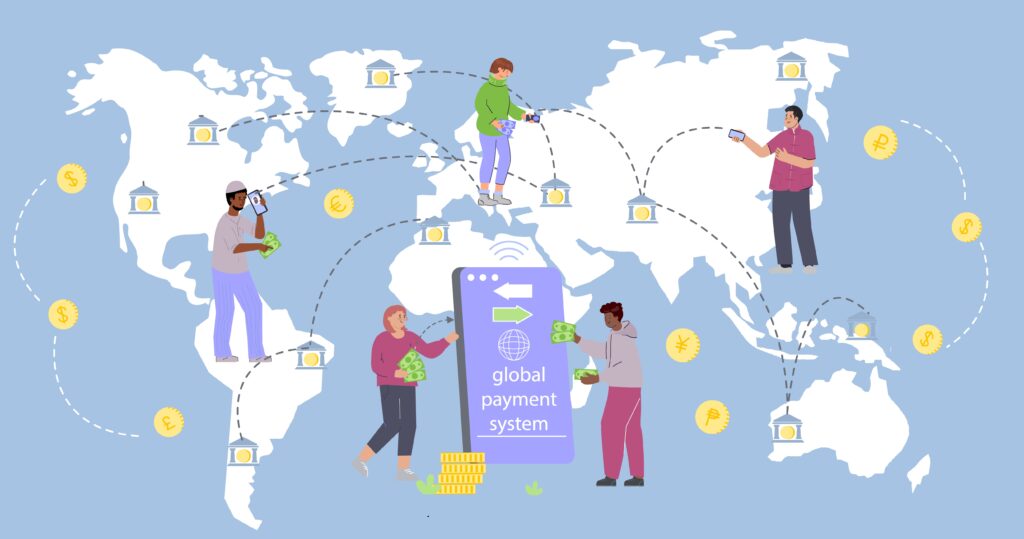
As cross-border payment volumes grow and settlement speed becomes a competitive necessity, legacy infrastructure is showing clear limitations. Cryptocurrencies and blockchain networks introduce a new settlement paradigm by removing dependency on fragmented, intermediary-driven systems.
Unlike traditional remittance models that rely on correspondent banking chains, crypto-based settlement operates on shared, distributed ledgers that are globally accessible. Transactions are validated and settled collectively by the network, rather than reconciled sequentially across multiple institutions. This architectural shift fundamentally changes how value moves across borders.
Within this model are several defining characteristics:
- Near-instant settlement, enabling value transfer in seconds or minutes rather than days
-
- 24/7 availability, removing dependency on banking hours, holidays, or time zones
-
- Programmable logic via smart contracts, allowing conditional payments, automated reconciliation, and embedded compliance rules
-
- Cryptographic security and auditability, ensuring tamper-resistant transaction records and end-to-end traceability
Critically, the role of cryptocurrencies in remittances is not centered on price appreciation or speculative use. Their primary value lies in their function as neutral, internet-native settlement rails capable of moving value globally with minimal friction.
Key Advantages of Crypto-Based Remittance Infrastructure
1. Real-Time or Near-Real-Time Settlement
Blockchain-based transfers can settle in seconds or minutes regardless of geography, currency corridor, or counterparty location. This dramatically improves cash flow for recipients and reduces working capital strain for payment providers, merchants, and platforms. Faster settlement also lowers counterparty and settlement risk, which remains a persistent issue in traditional cross-border payments.
2. Reduced Intermediation and Lower Costs
Crypto-based settlement minimizes reliance on intermediary banks, clearing houses, and correspondent networks. By reducing the number of parties involved in a transaction, fees become lower, more transparent, and easier to predict. Costs are driven primarily by network usage and infrastructure services rather than layered institutional markups, making pricing more competitive across both high- and low-volume corridors.
3. Improved Capital Efficiency
Traditional remittance systems require prefunded nostro accounts across multiple jurisdictions, tying up significant amounts of idle capital. Crypto rails eliminate this requirement by enabling just-in-time liquidity and atomic settlement. For payment service providers like YoguPay, fintechs, and marketplaces, this translates into more efficient treasury management and improved return on capital.
4. Enhanced Transparency and Traceability
Every transaction recorded on a blockchain is time-stamped, immutable, and traceable. This level of transparency simplifies reconciliation, reduces operational disputes, and strengthens auditability for both internal controls and regulatory reporting. When combined with compliance tooling and transaction monitoring, blockchain-based settlement can support robust AML and risk management frameworks.
5. Expanded Financial Access
Crypto wallets can be accessed through mobile devices without requiring traditional bank accounts, minimum balances, or geographic proximity to financial institutions. This makes crypto-based settlement particularly effective in regions with high mobile penetration but limited banking infrastructure. As a result, cross-border remittances can reach previously excluded individuals, SMEs, and digital businesses more efficiently.
In practice, these benefits are delivered through YoguPay’s API-driven infrastructure and Wallet-as-a-Service platform, which abstracts blockchain complexity for businesses and financial institutions. By embedding crypto settlement through our compliant channels, the technology becomes invisible to end users; while the speed, transparency, and efficiency of cross-border payments are fully realized.

Addressing the Misconceptions Around Crypto Remittances
Despite these advantages, skepticism remains. Concerns around volatility, compliance, and consumer protection are valid, but increasingly addressable.
- Volatility: Stablecoins pegged to fiat currencies significantly reduce price risk.
-
- Compliance: Regulated on-ramps, off-ramps, and blockchain analytics enable robust AML/CFT controls.
-
- Consumer Protection: YoguPay’s custodial wallet solutions and WaaS platforms introduce safeguards comparable to traditional financial services.
The narrative is shifting from “crypto versus banks” to “crypto-enhanced financial infrastructure.”
The Role of API Infrastructure and WaaS Providers
While blockchain networks provide the underlying rails, truly scalable remittance solutions require robust infrastructure built on top. That’s where YoguPay, as a cross-border API and Wallet-as-a-Service (WaaS) provider, plays a critical role, enabling businesses to deliver fast, compliant, and seamless global payments.
WaaS providers abstract the complexity of blockchain interactions, enabling fintechs, banks, and enterprises to integrate crypto-enabled payments without building from scratch.
These platforms typically offer:
- Custodial and non-custodial wallet infrastructure
-
- Multi-chain and multi-currency support
-
- Compliance and transaction monitoring
-
- Fiat on- and off-ramps
-
- Settlement and treasury management APIs
Cross-border settlement providers like also YoguPay operate at this intersection, bridging traditional finance and blockchain-based rails through compliant, enterprise-grade APIs.
YoguPay in the Emerging Settlement Stack
As remittance and settlement models evolve, infrastructure providers play a foundational role. YoguPay enables payment companies, digital wallets, and financial institutions to embed crypto-based settlement into their products without exposing end users to unnecessary complexity.
By providing:
- API-driven wallet infrastructure
-
- Cross-border crypto settlement capabilities
-
- Fiat-to-crypto and crypto-to-fiat conversion layers
-
- Compliance-aligned transaction workflows
As a provider, YoguPay helps transform cryptocurrencies from niche instruments into scalable financial plumbing.
In this model, cryptocurrencies become invisible to the end user; while benefits such as peed, cost reduction, transparency, and access are fully realized.

Use Cases Redefining Global Money Movement
Crypto-enabled settlement is already reshaping how value moves across borders, particularly in areas where traditional infrastructure is slow, costly, or inaccessible. These use cases illustrate how blockchain-based rails are being applied in practical, high-impact contexts.
1. Migrant Worker Remittances
Crypto-enabled remittance corridors significantly reduce both transaction costs and settlement times for migrant workers sending money home. Faster settlement ensures recipients gain immediate access to funds, while lower fees preserve a greater share of income for essential household needs. When delivered through compliant wallet infrastructure, these solutions provide a more reliable alternative to cash-based and informal channels.
2. SME Cross-Border Payments
Small and medium-sized enterprises often face disproportionate friction when making international payments, including high FX spreads, delayed settlement, and complex banking requirements. Stablecoin settlements allows SMEs to pay overseas suppliers in near real time without relying on multi-layered correspondent banking networks. This improves supplier relationships, enhances cash flow predictability, and enables smaller businesses to compete globally.
3. Platform and Marketplace Payouts
Global platforms and digital marketplaces increasingly operate with distributed workforces and seller networks. Using a unified crypto settlement layer, platforms can automate payouts to creators, contractors, and merchants across multiple countries with greater speed and transparency. This approach reduces operational overhead while providing recipients with faster access to earnings in their local currency.
4. Treasury and Liquidity Management
Enterprises with international operations can use crypto rails to streamline internal fund movements across regions. Just-in-time settlement reduces idle capital, improves liquidity visibility, and supports more efficient treasury operations. For multinational businesses, this creates a more agile and responsive financial structure.
Regulatory Convergence and the Path Forward
Early concerns that regulation would impede crypto-based remittances are giving way to a more nuanced reality. Regulators across major and emerging markets are developing clearer frameworks governing:
- Stablecoins
-
- Virtual asset service providers (VASPs)
-
- Cross-border crypto transfers
Globally, frameworks like the U.S. GENIUS Act and the EU’s MiCA have laid the foundation for regional crypto regulation, with Kenya’s Virtual Asset Service Providers Act being the first of its kind in Africa, offering comprehensive oversight of digital assets.
This growing regulatory clarity is accelerating institutional participation and encouraging investment into compliant, enterprise-grade infrastructure. As standards mature, interoperability between traditional payment systems and blockchain networks will continue to improve, enabling hybrid models that combine regulatory oversight with technological efficiency.
For banks and payment service providers, integrating crypto on- and off-ramps no longer requires complex in-house development. Today, YoguPay’s RESTful APIs enable plug-and-play integration, combining compliant wallet services, fiat-to-crypto conversion, and reliable cross-border settlement rails in a single stack.
This allows institutions to support global payments more efficiently while maintaining regulatory alignment and operational control.

Invisible Infrastructure as The Future of Remittances
The future of remittances is not defined by end users choosing crypto over banks, but by infrastructure that delivers faster, cheaper, and more inclusive outcomes regardless of the underlying technology. Blockchain-based settlement increasingly operates behind the scenes, abstracted through APIs and compliant platforms.
In this emerging model:
- Blockchain networks handle settlement
-
- APIs abstract technical complexity
-
- WaaS providers manage wallets, compliance, and custody
-
- End users experience seamless global payments
Traditional remittance models are breaking because they were never designed for a borderless digital economy. Cryptocurrencies, when paired with robust infrastructure providers such as WaaS and cross-border settlement platforms, are not just fixing what is broken, they are quietly redefining how global money movement works at scale.

Conclusion
Cross-border remittances sit at the intersection of human need and global commerce. As traditional systems strain under their own complexity, the shift toward crypto-enabled settlement is becoming inevitable.
The real innovation lies not in the asset class itself, but in how it is embedded into scalable, compliant, and user-centric infrastructure. API-first WaaS and cross-border settlement providers are quietly building the backbone of this new financial layer.
As the industry moves forward, the question is no longer whether traditional remittance models will change, but how quickly modern infrastructure will replace them. YoguPay provides the API-driven foundation for crypto-enabled cross-border settlement, designed to eliminate legacy bottlenecks while meeting the demands of regulated financial institutions.Visit www.yogupay.com or speak with our team to learn how to build a scalable, compliant payment stack for global value movement.
